+90 534 226 60 59
  Mon - Fri: 9:00-18:00; Sat: 9:00-17:30; Sunday: Closed

Dental implants and bridges are the most popular tooth replacement options at Perla Dental Clinics. A dental implant treatment uses an implant post to replace the missing tooth root in the jawbone. A dental bridge uses the intact adjacent teeth for support and requires teeth preparation.
The choice between these treatments depends on the patient’s case and preferences. They have different upfront and long-term costs and place different requirements on oral health and jawbone condition.

Table of Contents
Dental Implant vs Bridge: Quick Answer for Missing Teeth
Dental implants and bridges are both used for restoring missing teeth. A dental implant treatment replaces the tooth root with an implant post that can support a crown or another restoration. A dental bridge uses neighbouring teeth to support a restoration for a missing tooth without replacing the root.
Dental implant vs bridge at a glance
- Impact on adjacent teeth: Dental bridges alter and are supported by adjacent teeth; implants are not.
- Jawbone requirements: Bridges may be placed in patients with a jawbone condition that is insufficient for implants
- Treatment time: Dental implants require a long recovery. Dental bridge treatments are considerably faster.
- Cost and suitability: Dental bridges are usually less expensive than dental implants.
Who Needs Full Mouth Reconstruction?
The main difference between dental implants and bridges is in how they support the restoration. Dental implants are supported by the jawbone, using the implant post placed into it. Dental bridges use adjacent teeth for support.
These differences affect the treatments’ complexity and indications. There are benefits and tradeoffs to both approaches, and suitability depends on the patient’s case.
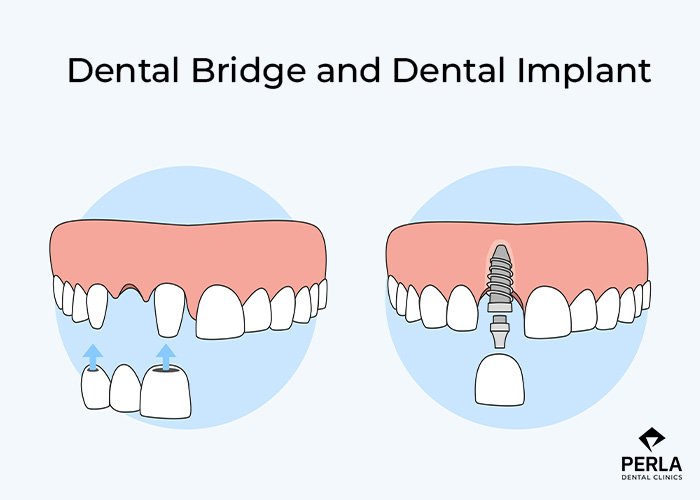
How a Dental Implant Replaces the Tooth Root
A dental implant uses an implant fixture, also called a post, to support a crown or other restoration. The implant fixture is placed into the jawbone and serves as an artificial tooth root. The fixture and the crown can connect using a separate component called an abutment.
Placing an implant requires more time than a bridge. The recovery period required for an implant to support a fully usable crown lasts several months. However, the long-term stability of implants can be higher.
How a Dental Bridge Fills the Gap
The element of the dental bridge that fills the gap left by a missing tooth is called a pontic. Unlike implants, the pontic is not supported by the jawbone. Usually, it connects to dental crowns that are fitted onto adjacent teeth. The pontic, therefore, bridges the gap, hence the name of the dental prosthesis.
The exact method used to prepare the teeth for the bridge varies by bridge type. Some bridges do not use crowns and are instead connected to minimally prepared adjacent teeth via a framework or ‘wings’. However, in all cases, the pontic is not supported by the jawbone directly.
Dental Implant vs Bridge Comparison Table
| Factor | Dental Implant | Dental Bridge | What this means for the patient |
|---|---|---|---|
| Support | Jawbone | Adjacent teeth | The current condition of the jawbone and adjacent teeth is a factor in choosing the treatment |
| Impact on adjacent teeth | Low. Does not require altering healthy teeth | High. May require altering healthy teeth to a varying degree. | Bridges may not be suitable for patients whose teeth cannot support them |
| Impact on the jawbone | High, but can preserve jawbone density | Lower, but does not protect from bone loss | Patients with insufficient jawbone parameters may require bone grafts or may be ineligible for implants |
| Treatment time | Longer | Shorter | Bridges can provide a more immediate restoration |
| Recovery | Longer | Shorter | Bridges can provide a patient with functional teeth sooner |
| Upfront cost | Higher | Lower | Budget considerations can impact the choice between these treatments |
| Long-term value | Higher | Lower | Implants tend to last longer and require less expense in the long term |
| Maintenance | Tends to be easier | Tends to be more difficult | Bridges are less similar to natural teeth in maintenance and more reliant on the health of adjacent teeth |
| Suitability | Patients with adequate jawbone health who want a long-term restoration that does not depend on other teeth | Patients who want a faster, less expensive replacement for missing teeth, or who do not have adequate jawbone parameters | The choice between treatments is made depending on the clinical case, patient preferences, budget, and health of the adjacent teeth and the jawbone |
Adjacent Teeth and Jawbone: The Two Biggest Clinical Tradeoffs
The trade-offs between dental implants and bridges stem from their impact on adjacent teeth and the jawbone. They impact these areas differently, so which treatment is better for the patient’s case can only be determined after an assessment.
Why this matters:
- Healthy neighbouring teeth are required for bridges, but not for implants.
- Implants are more sensitive to bone and gum conditions.
- Use of one treatment over the other may influence future treatment options.
- The difference between bridges and implants affects how convenient they are to clean and maintain.
Neighbouring Teeth and Tooth Preparation
Most dental bridges use adjacent teeth for support. The condition of these teeth is very important for treatment success.
In most cases, the neighbouring teeth serve as abutment teeth. During tooth preparation, some of the tooth enamel is shaved down to fit a crown. These crowns then connect to and support the pontic. Less invasive ways to prepare an abutment tooth exist, but may not be suitable for every case.
A dental bridge can fail if the abutment tooth becomes damaged or decays. As such, the longevity of bridges depends heavily on maintaining the health of their supporting teeth.
Jawbone, Bone Density and Implant Suitability
Dental implants are inserted into the jawbone, so the jawbone’s condition and dimensions are important factors in treatment planning. A jawbone with insufficient density cannot provide enough primary stability for the implant.
Gum health also plays an important role. Implant success rates are higher when placed in patients with healthy gums and good jawbone condition. A history of gum disease may indicate a higher chance of gum-related complications. While implants place heavy demands on the jawbone, they can also stop bone loss. This can help preserve jawbone health in the long term.
Treatment Time, Procedure and Recovery
Dental implants and bridges have different average treatment times. Dental bridges require tooth preparation and fitting, while implants are placed surgically and require a recovery period for a stable connection with the jawbone.
This means dental bridge treatments require less time to complete. For international patients, an implant usually requires two visits to Turkey, separated by 3-6 months of recovery; a bridge can be done in one visit that lasts about a week.
Implants require a healing period to fuse with the jawbone and obtain strong secondary stability. Soft tissue healing after surgery takes less time.
Questions to ask before planning travel for dental implants or bridges:
- What type of dental imaging will be used before treatment?
- How many visits to Turkey will there be?
- What temporary restoration will be fitted during recovery?
- How is a healing review conducted after the procedure?
- What happens after I return home?
Cost: Upfront Price vs Long-Term Value
Dental bridges usually have a lower upfront cost. Dental implants are more expensive initially, but the long-term cost may be lower due to higher average longevity. The treatments involve different planning and treatment protocols, which influence their prices.
At Perla Dental, a dental bridge costs £525. Implants cost between £430 and £780, depending on the brand. A zygomatic implant costs £1,650. And full teeth replacement packages start from £3,700. You can find more about the tooth implant prices in Turkey in our article.
When choosing between a bridge and an implant, compare these cost factors:
- Treatment complexity: Treatments that involve additional procedures, such as bone grafts, can cost more in total.
- Imaging: If a treatment involves advanced imaging, such as 3D dental scans, it can be more expensive.
- Temporary teeth: Temporary crowns and bridges influence the cost, if included.
- Lab work: Restorations that are more expensive to manufacture cost more.
- Surgery: Dental surgery requires more care and experience, so treatments that require it are more expensive.
- Materials: Both implants and bridges can use different materials, some of which are more expensive than others.
- Aftercare: Treatments that require more involved aftercare procedures can be more expensive.
- Future maintenance: Costs of long-term maintenance depend on the type of restoration, its expected service life, and the patient’s overall dental health.
Who May Be Suitable for an Implant or a Bridge?
Whether a patient can get a bridge or an implant depends on the current condition of the gums, jawbone, and adjacent teeth. Dental health history and results of dental assessment are also considered when determining suitability for dental restorations.
A dentist may consider:
- Adjacent teeth condition
- Gum health
- Jawbone density and dimensions
- Medical history, such as uncontrolled diabetes and recurring gum disease
- Smoking or other types of nicotine consumption
- Patient’s budget considerations and preferred treatment timeline
When a Bridge May Be Considered
A bridge may be considered for cases where the condition of the neighbouring teeth and the patient’s case are favourable for this restoration. Bridges can only restore a certain number of consecutively missing teeth. As such, patients who have lost many consecutive teeth may be ineligible for traditional dental bridges.
When an Implant May Be Considered
An implant may be considered when the patient’s oral health, jawbone and gum condition support placing an implant fixture. A patient may require bone grafts or sinus lifts to become eligible for implants.
Implant fixtures can be used to support crowns and implant-supported bridges. This allows replacing any number of teeth if the patient’s oral health condition allows for it. Determining eligibility for implants is only possible after assessment and dental imaging.
Maintenance, Cleaning and Aftercare
Dental implants and bridges require daily cleaning and regular dental check-ups for optimal longevity. Cleaning and maintenance methods can be different, however.
Traditional bridges require cleaning under the restoration, while dental implants with crowns can be cleaned in a way that is more similar to cleaning natural teeth. The actual maintenance protocol can differ between implant and bridge types and should be discussed with the dentist.
Clarify the following aftercare points with the dentist:
- Restoration daily cleaning recommendations
- Necessary professional check-up frequency
- Gum and overall oral health warning signs
- Treatment follow-up plan
- Who to contact for questions after returning home
Bridge Types and Alternatives to Keep in Context
Maryland and implant-supported bridges are alternative bridge types that may be preferred in some cases. Their use requires separate assessment.
Maryland bridges use adjacent teeth for support, but do not use crowns. They connect to the natural teeth with metal or porcelain wings. This requires less tooth preparation, but can be less stable. This type of bridge may also be called a resin-bonded bridge.
Implant-supported bridges do not use natural teeth for support. They use implant fixtures for support. This allows the dentist to replace many teeth using a relatively low number of implants.
Do not confuse:
- Standard bridge: Uses crowns fitted on adjacent teeth.
- Maryland bridge: Uses metal or ceramic wings connected to adjacent teeth.
- Implant-supported bridge: uses implant posts instead of adjacent teeth for support.
Dental Implant vs Bridge FAQ
Is It Better to Have a Bridge or an Implant?
Which restoration is better for your case depends on clinical considerations. The choice also depends on your overall dental health, budget considerations, and preferred treatment duration. The dentist can advise you on which treatment may be better for your case after a consultation.
Is a Bridge Cheaper Than an Implant?
Bridges are usually cheaper than implants. They are placed without surgery or a long recovery. However, implants can cost less in the long term.
Why Would a Dentist Not Recommend an Implant?
A dentist may advise against an implant if the patient’s jawbone condition or general health is insufficient for the treatment. For example, a history of gum disease may imply that a patient is more prone to peri-implantitis. If such patients have other oral health conditions that can affect treatment success, a dentist may recommend an alternative treatment.
Why Would a Dentist Not Recommend a Bridge?
Dental bridges rely heavily on the teeth surrounding the gap left by a missing tooth. A dentist can advise against a bridge if these teeth are not healthy. A dental bridge may also be unsuitable for patients who have lost too many consecutive teeth.
Can an Implant Replace a Bridge Later?
An implant can replace a bridge in some cases. Since a bridge does not protect against bone loss, the jawbone condition may become less favourable for an implant over time. A patient may require a bone graft when replacing a bridge with an implant. Additionally, the abutment teeth will need to be refitted with new crowns.

Medically reviewed by:
Dr. Onur Ademhan
Oral and Maxillofacial Surgeon
Founder and CEO of Perla Dental Clinics. Graduated from Ankara University Faculty of Dentistry and specialized in Oral and Maxillofacial Surgery at Gazi University.
Next Step: Get a Case-Based Treatment Plan
The safest way to choose between tooth restorations is to request a case-based assessment. Remember to:
- Provide current dental X-rays or CBCT, if available.
- Share photos and dental history when requested.
- Mention your relevant medical history and smoking status.
- Request a written treatment plan, itemised quote, and follow-up plan.
Contact Perla Dental Clinics for an online consultation and suitability assessment, and let our experts help you choose a tooth replacement option and create a personal treatment plan.