+90 534 226 60 59
  Mon - Fri: 9:00-18:00; Sat: 9:00-17:30; Sunday: Closed

Molar tooth implants replace missing back teeth with an implant fixture and a crown.
This guide will help UK and international patients who want to replace missing molars with implants at Perla Dental Clinics better understand the treatment. We explain patient suitability, cost factors, alternatives, and treatment planning in Turkey.
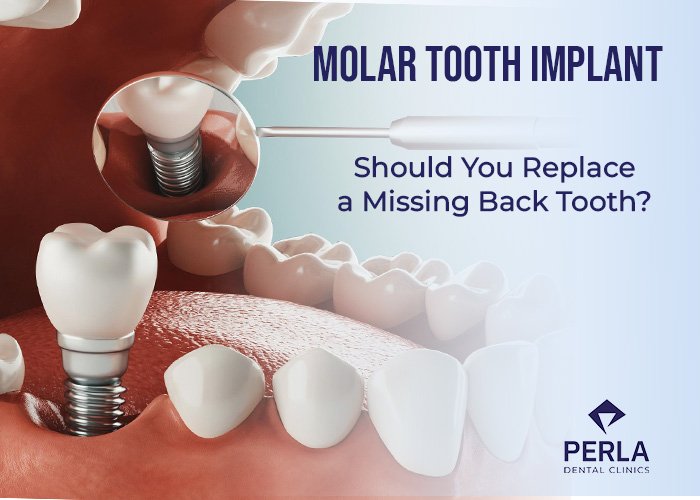
Table of Contents
What Is a Molar Tooth Implant?
A molar tooth implant replaces a posterior tooth with an implant fixture and a dental crown. The dental crown replaces the parts of the molar above the gum, while a fixture is placed in the jaw to support the crown, similar to other dental implants in Turkey.
Molars experience a heavy chewing load, so dental implants for molars need sufficient bone, bite, and gum health for proper support. Treatment planning for molar implants accounts for these factors. It can use implant fixtures of different diameters and a range of preparatory procedures to strengthen the restored tooth.
Do You Really Need an Implant for a Missing Back Molar?
Missing a molar tooth can affect chewing and occlusion, and impact neighbouring and opposing teeth over time. However, the need for a molar tooth replacement depends on which molar is missing and the patient’s clinical case and goals.
These factors are considered when deciding on a molar dental implant in Turkey:
- How tooth loss affects the bite and chewing comfort.
- Movement of remaining teeth due to tooth loss.
- Patient’s current gum and jawbone health.
- Jawbone dimensions and density.
- Budget considerations.
- Readiness to travel for a dental implant.
Can You Live Without a Second Molar?
Some people can live with a missing second molar. Whether its loss requires replacement in your case depends on how it impacts your comfort and dental health. There may be future risks to not using an implant for a missing molar, so we recommend that you make your decision only after undergoing a dental check-up. When considering whether you need an implant for a second molar, remember that online opinions do not replace a dentist’s advice.
Molar Implant Suitability: Jawbone, Gum Health and Long-Missing Teeth
Molar implant suitability depends on the patient’s jawbone volume, gum and overall oral health, bite, and medical history. Dental imaging is also an important factor that can reveal underlying bone conditions. Patients with a long-missing tooth may require closer examination, as long-term changes to adjacent and opposing teeth after tooth loss can affect implant suitability.
For a molar implant procedure in Turkey, international patients can get a pre-treatment consultation online. It can use existing dental photos and panoramic X-rays. This results in a written personal treatment plan that confirms broad suitability for molar implants.
What the dentist considers when determining molar implant suitability:
- Jawbone condition, bone density and dimensions.
- Gum health.
- Proximity of sinuses and nerve canals.
- Bite stability and occlusion.
- Overall dental and general health.
- Prescribed medication taken by the patient.
- Nicotine consumption habits.
When Bone Grafting or a Sinus Lift May Be Discussed
Bone grafting and sinus lifts are used when a dental examination shows that the patient’s jawbone requires extra support for the implant, or the sinus cavity extends too close to the implant site.
A dental bone graft can help improve bone density and dimensions, while sinus lifts can only be a factor for implants in the upper jaw. Bone grafts and sinus lifts, when required, may affect total treatment cost, planning, and timing.
Molar Implant Procedure: From Consultation to Crown
A molar implant procedure involves consultation and treatment planning, implant placement, recovery, and restoration placement, typically a crown. Additional procedures may be included before or during implant surgery, if the patient’s case requires them.
Steps of molar dental implant treatment:
- Consultation and treatment planning: Determines patient suitability and helps prepare for the treatment.
- In-clinic examination and dental scans: help create a precise model of the patient’s oral anatomy for use during implant surgery.
- Implant placement surgery: Places an implant fixture into the jawbone.
- Recovery and osseointegration: Healing of the jawbone and gums, and forming a structural connection between the bone and the implant fixture.
- Final restoration placement: Attaching a final crown and an abutment to the implant fixture.
- Review: Assessment of crown fit and patient comfort using the final restoration.
These steps can be different for some patients. This depends on the patient’s case and the type of dental implant.
Implant Fixture, Abutment and Crown
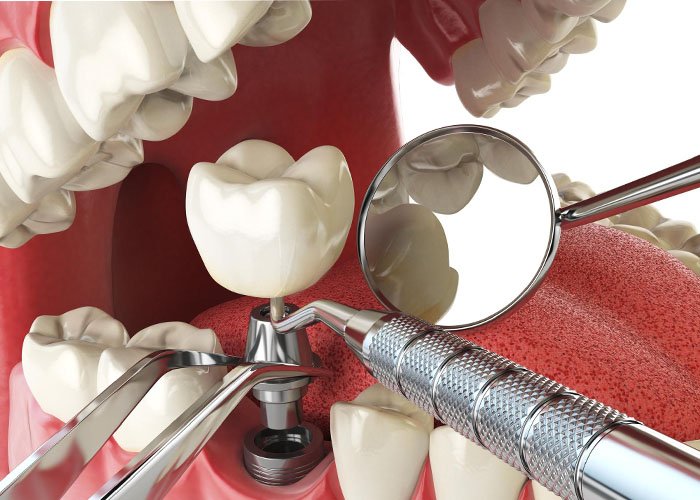
A single molar dental implant system usually consists of three components: an implant fixture, an abutment, and a crown. A fixture is a screw-shaped piece that replaces a dental root and is placed into the jawbone. An abutment is a connector that attaches a dental crown to the fixture. A dental crown is used to replace the visible parts of the tooth.
The dental crown’s construction and material are chosen to withstand the chewing loads experienced by molars.
Pain, Healing, Risks and Aftercare
The level of discomfort, swelling, and soreness during molar implant recovery varies from patient to patient. Following the dentist’s recommendations during this period is important for prompt healing and minimising avoidable risks.
Patients may need to follow a soft-food diet during the initial recovery and adjust their oral hygiene routine to avoid disturbing the implant site.
Perla Dental provides written post-operative instructions which describe the aftercare protocol, recommended diet, and prescribed medications for the recovery period. Patients can contact us via WhatsApp for additional support after returning to the UK.
Ask your dentist about:
- Pain control after and during surgery.
- Expected swelling during initial recovery.
- Diet restrictions.
- Oral hygiene recommendations.
- Possible warning signs.
- UK follow-up protocol.
Contact the clinic immediately if you experience severe pain, swelling, bleeding, or other worrying symptoms during recovery. You can learn more in our ‘Do dental implants hurt’ article.
Molar Implant Cost Factors in Turkey
Molar implant cost depends on the implant brand, system, and case complexity. Crown and fixture material, bone grafting, and other additional procedures also influence the price.
The cost of a single-tooth implant in Turkey is heavily influenced by brand. At our clinic, costs range from £400 for Megagen Anyone to £780 for Straumann Roxolid Active. Total treatment price depends on the patient’s case and is explained in the written itemised quote.
What should be mentioned in the implant quote:
- Dental imaging.
- Implant fixture.
- Implant abutment.
- Implant crown.
- Bone grafts/sinus lifts.
- Additional travel-related services: in-country transfers, accommodation, etc.
- Aftercare support.
Molar Implant vs Bridge or Partial Denture
A dental bridge or a partial denture may be a viable molar tooth replacement for some patients. This depends on the condition of the remaining teeth, gum health, budget considerations and patient goals.
Dental bridges use neighbouring teeth for support. Partial dentures use clasps or a metal framework for stability. You can find more details about both treatments in our articles: ‘Dental bridge in Turkey’ and ‘Types of dentures’.
| Restoration | Key advantages | Possible drawbacks | What to ask your dentist |
|---|---|---|---|
| Implant | Does not require the preparation of adjacent teeth. Prevents bone loss | High upfront cost. Surgical procedure. Long recovery | Are implants the best option for my case? Do I need extra procedures before implant surgery? |
| Bridge | Fixed restoration. Lower upfront costs and recovery. | Permanently alters adjacent teeth. Does not prevent bone loss. | How to adjust my oral hygiene routine to clean under the bridge? |
| Partial Denture | Relatively non-invasive. Tends to be the most affordable alternative | Can be bulky. Needs regular adjustments. Does not prevent bone loss. | How often will my denture need to be adjusted or relined? |
| No Immediate Replacement | No immediate expense | May cause progressive bone loss and movement of adjacent teeth. Can impact bite and comfort. | Can my choice affect the positions of my remaining teeth? Will it impact future treatment possibilities? |
Is Travelling to Turkey Worth It for One Molar?
Travelling for a single molar dental implant may make sense if the treatment plan suits your goals and budget.
Before booking travel, remember to:
- Provide dental X-Ray or CBCT scans, if requested.
- Get a written treatment plan and quote.
- Clarify if a bone graft or sinus lift may be required.
- Clarify how many visits to Turkey you will need.
- Ask about the clinic’s aftercare policy.
- Confirm with the dentist that the treatment is suitable for you.
Perla Dental Clinics provides emergency and post-return support on our implants. We will cover the flight and accommodation for you to return to Turkey to resolve problems with your restoration that is covered by this policy.
We offer online consultations and emergency contact with the patient coordinator to help answer patient questions. Request a dentist-reviewed treatment plan at our clinic to learn more about molar implants and if they are suitable for your case.
Molar Tooth Implant FAQs
Is It Worth Getting an Implant for a Back Molar?
If the loss of a molar has negative effects on dental health or comfort, an implant may be a suitable treatment. Difficulty chewing, bite issues, jawbone resorption, and movement of adjacent teeth can all occur after tooth loss. Consult the dentist to learn if not replacing the tooth immediately can impact any future treatments.
How Painful Is Getting a Molar Implant?
Patient experiences during and after implant surgery can vary. The surgery itself is conducted under anaesthesia. Some swelling and soreness are typical after the surgery. Discuss pain control with a dentist. Severe pain, swelling, bleeding, fever, and implant mobility are always causes for concern. Contact the clinic if you experience them.
Can a Molar Implant Work If the Tooth Has Been Missing for Years?
A molar implant may work for patients who have been missing their teeth for several years. However, suitability depends on the individual case. Such patients are more likely to have insufficient bone or gum support. In such cases, a bone graft or a sinus lift can be a prerequisite for an implant surgery.
Next Step: Get a Clinician-Reviewed Treatment Plan
The next step to molar dental implants in Turkey is to get a dentist-reviewed treatment plan that confirms your suitability for the treatment and includes a personal quote.
When contacting our clinic:
- Provide dental photos, X-rays, and/or CBCT scans as requested.
- Share relevant medical history.
- Describe your current symptoms and treatment goals.
- Ask for an itemised quote for UK patients.
- Confirm if you may need a bone graft or a sinus lift.
- Confirm your aftercare coordinator contact and post-surgery care details.

Medically reviewed by:
Dr. Onur Ademhan
Oral and Maxillofacial Surgeon
Founder and CEO of Perla Dental Clinics. Graduated from Ankara University Faculty of Dentistry and specialized in Oral and Maxillofacial Surgery at Gazi University.