+90 534 226 60 59
  Mon - Fri: 9:00-18:00; Sat: 9:00-17:30; Sunday: Closed

If you are considering getting dental implants in Turkey, you may have noticed that there are several types of dental implants available.
Implants help replace missing teeth, preserve facial structure, and improve smile aesthetics. The choice depends on the number of missing teeth, jawbone density, and other factors.
This article will help you understand the core differences between the kinds of tooth implants, allowing you to make a well-considered decision with your implantologist.
Table of Contents
What Are Dental Implants and How Do They Work?
Before considering implant types, it is important to define what a dental implant is. In their most common form, dental implants are like artificial roots. They can anchor a dental crown or bridge and are used to replace one or more of your teeth.
Normal dental crowns and bridges can only repair the visible portion of the tooth above the gum line. Implant systems, on the other hand, replace the entire tooth.
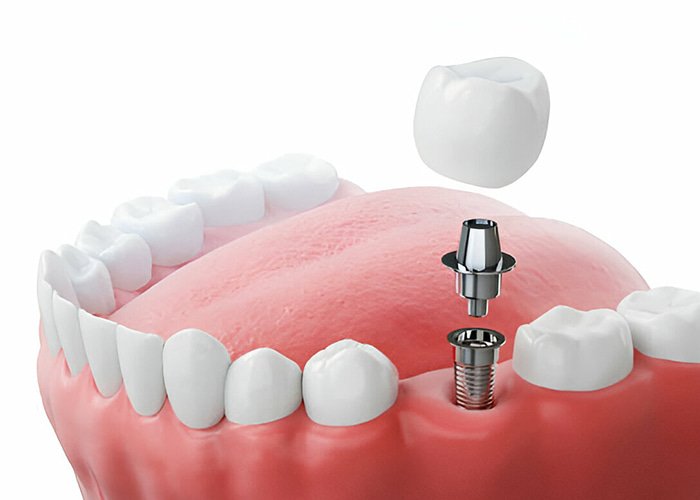
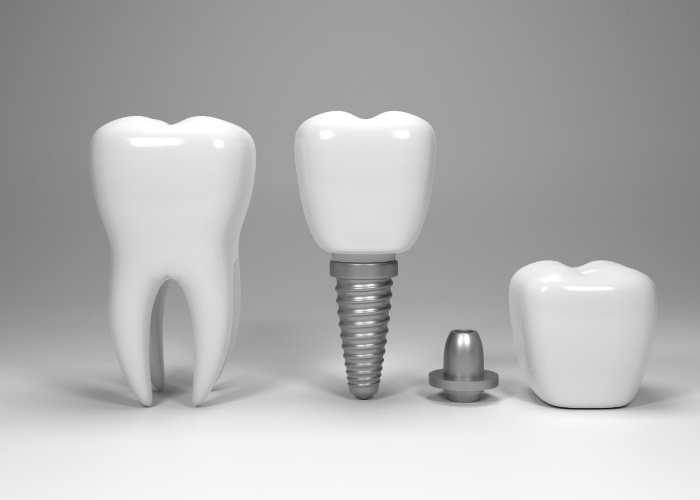
A typical implant system consists of a screw that serves as an artificial tooth root, a crown, and an abutment that connects the two. The use of implant screws allows the dentist to place bridges and crowns without altering adjacent healthy teeth.
When used for full-mouth restorations, the main difference between dental implants and dentures is in how the artificial teeth are anchored:
- Traditional dentures sit on the gums, limiting bite pressure.
- Implants replace tooth roots, so the full-arch restoration anchored to implants feels more like natural teeth.
Main Types of Dental Implants by Position in the Jaw
One way to classify dental implants is by their position in the mouth. When most patients think about dental implants, they picture a screw-shaped endosteal implant.
However, other options are available. Although far rarer, these can be a great alternative when you are not a suitable candidate for an endosteal implant due to medical conditions or preferences.
Implant comparison
| Key factors | Endosteal | Subperiosteal | Zygomatic | Transosteal |
|---|---|---|---|---|
| Prevalence | Very common | Rare | Uncommon | Historical |
| Best for | Most patients | Poor bone quality | Atrophied upper jaw | Specific lower jaw needs (largely obsolete) |
| Position in the jaw | In the jawbone | On the jawbone | In the cheekbone | Through the lower jawbone |
1. Endosteal Implants (Standard Root-Shaped Implants)
Installation:
- Placed into the jawbone
- Screw-shaped fixtures (artificial roots)
Indications:
- Patients with sufficient bone volume and quality
- Healthy gums
Prosthesis options (artificial teeth):
- Single tooth crowns
- Implant-supported bridges
- Overdentures
Endosteal implants are the most common type of dental implant today. These are ‘in the bone’ implants. They consist of a screw-shaped fixture that is installed into the jawbone. The screw replaces the tooth root and is connected to an artificial crown or bridge via an abutment.
Since endosteal implants are the most commonly used type of implant, their installation protocols are more flexible. Implant installation surgery involves exposing the jawbone and preparing precise channels for the implant screws. Endosteal screws derive their strength through osseointegration. Osseointegration is a process by which the implant screw fuses with the surrounding bone after installation.
Since osseointegration is vital to treatment success, this type of dental implant requires sufficient bone quality and volume. Bone augmentation, such as bone grafting, are often used to strengthen the jawbone structure before implant surgery.
Endosteal implants can be installed as single tooth implants or to stabilize dental bridges or prostheses. Endosteal screws are also used in full-mouth dental implants. The possibility of restoring any number of teeth is another factor that has made endosteal screws the standard dental implants today.
2. Subperiosteal Implants (On-Top-of-Bone Implants)
Installation:
- Placed between the bone and the gums
- Titanium framework tightly surrounds the bone
Indications:
- Patients with poor bone quality
- Jawbone with severe bone loss (atrophy)
- Repeated bone grafting failure
Prosthesis options (artificial teeth):
- Dental bridges
- Overdentures
Subperiosteal implants are ‘on top of bone’ implants. They generally do not require modifying the jawbone. The custom-made metal frame of the implant rests between the jawbone and the gums.
The modern installation procedure for subperiosteal implants uses CT scanning to capture the bone anatomy. CAD/CAM technology is used to make a custom implant framework.
During the surgery, the doctors will expose the jawbone. The implant framework is then placed to fit tightly around the bone. After the gums have healed, the artificial teeth can be fitted on the posts that pass through the gums.
Subperiosteal framework is a dental implant option for patients whose jawbone cannot support an endosteal screw and who cannot be treated with bone grafting. Patients with multiple graft failures are typical recipients.
Advances in bone grafting and augmentation have made the use of this implant less common, with more people becoming suitable for endosteal screws. In some cases, more modern implant options, such as zygomatic implants, are preferred for their stability.
Subperiosteal implants are usually used for implant-supported bridges and overdentures. Patients who are most eligible for a subperiosteal implant usually need a full-arch prosthesis. Subperiosteal single-tooth implants exist, but this is a very niche treatment option.
3. Zygomatic Implants (For Severe Upper Jaw Bone Loss)
Installation:
- Installed into the cheekbones (zygoma)
- Rod-shaped artificial roots
Indications:
- History of implant or sinus lift failure in the upper jaw
- Severe atrophy of the upper jaw
Prosthesis options (artificial teeth):
- Full-arch fixed bridge
Zygomatic implants look like very long endosteal implants. However, they anchor in the cheekbones, not the jawbone. They are only suitable for the upper jaw and are used for patients who are otherwise ineligible for conventional implants.
The general treatment steps for this type of implant are similar to installing endosteal screw-shaped implants. The main difference is that zygomatic posts are longer, reaching into the cheekbones, and angled to avoid sensitive tissue.
Zygoma implants are used with full-arch fixed bridges. Zygoma implant posts are used to support the posterior part of the full-arch denture. This is because bone loss is usually more pronounced in the back of the jaw. Several conventional implants anchor the front part of the bridge.
This combination of implants offers great stability and high treatment success rates in patients with severely deficient upper jaw quality.
4. Transosteal Implants (Rare & Historical Type)
Transosteal dental implants consist of a staple-like metal plate with posts extending from it. This is a ‘through-the-bone’ implant formerly used for treating lower jaws.
The plate is installed on the opposite side of the jawbone, while the posts pass through the bone. The dental prostheses are anchored to the posts. Transosteal surgery requires making an incision under the chin.
The complexity, long recovery, and high chance of complications have made this type of implant mostly obsolete. Today, most patients opt for more modern types of dental implants following careful treatment planning and jawbone augmentation.
Types of Dental Implants by Treatment Scope
Defining different types of implants by treatment scope is more intuitive for the patient. Implants can anchor more than one tooth at once. Therefore, suitable treatment options are available for most cases, whether you need to replace a single tooth or restore an entire dental arch.
Your dentist will help you choose the appropriate type of implant during treatment planning. However, you can estimate the scope based on how many teeth you need to replace.
1. Single-Tooth Dental Implants
Teeth restored:
- One per implant
Indication:
- Restoring non-adjacent missing or damaged teeth
Single tooth implants use one implant screw per restored tooth. The visible part of the system is an implant-supported crown. The dentists will recommend this type of tooth replacement when the number of teeth to be replaced is low, and they are located in different parts of the mouth.
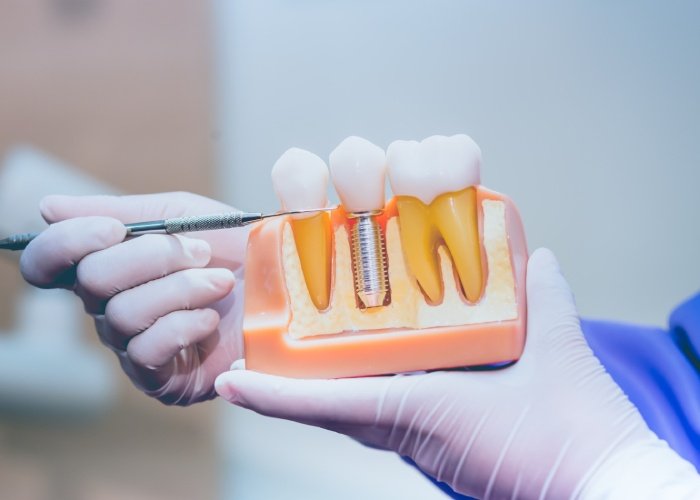
These implants can also be used as an alternative to removable bridges. Unlike a bridge, which requires altering some of the neighbouring teeth, an implant allows you to preserve your healthy teeth.
Most patients who need a single tooth implant do not suffer from advanced jawbone atrophy. This increases the chances of using immediate or early loading protocols, allowing the dentist to install an artificial tooth within a week after implant placement.
Single-tooth surgery is shorter than for other implants, allowing patients to spend less time at the clinic.
2. Implant-Supported Bridges (Several Missing Teeth in a Row)
Teeth restored:
- 3-4 with two implants
- 5-7 with three or more implants
- 8+ with 4-8 implants
Indication:
- Restoring multiple adjacent missing or damaged teeth
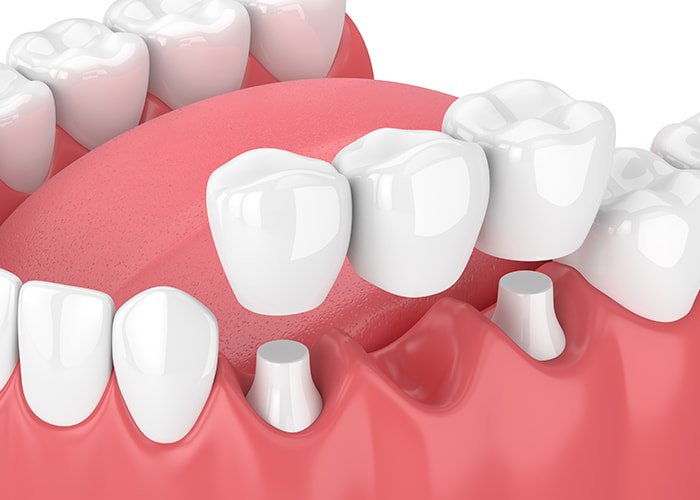
An implant-supported bridge uses several implant screws to restore multiple adjacent teeth. It is similar to conventional dental bridges in Turkey, but uses implants as attachments instead of adjacent healthy teeth.
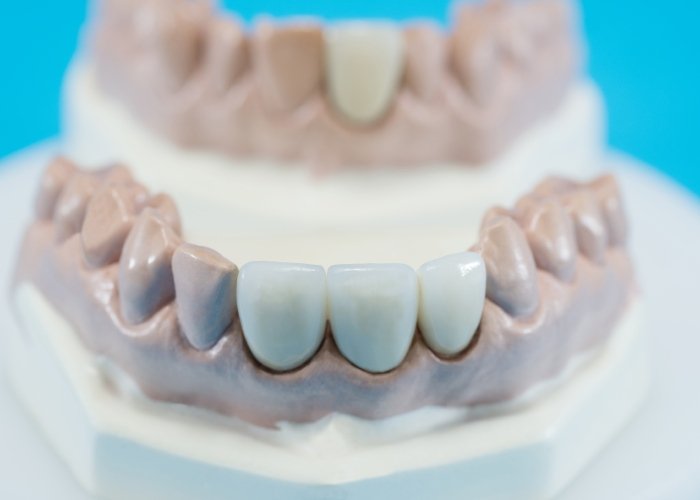
Most implant-supported bridges use two or more implant screws. They are suitable for patients who have several adjacent missing teeth.
There are many dental implant options for bridges. The most common configuration is a bridge that restores three or four teeth and is supported by two screws.
Many other types are possible, allowing patients to restore up to 12-14 teeth with a full-arch bridge. Single-implant cantilever bridges for two teeth are also possible, but are rare.
Implant-Supported and Conventional Bridge Comparison
| Key factors | Implant-supported bridge | Conventional bridge |
|---|---|---|
| Cost | Higher upfront cost | Lower upfront cost |
| Longevity | More than 15 years | 10-15 years |
| Support | Implants | Adjacent natural teeth |
| Span | 2-14 teeth | 3-4 teeth |
| Impact on surrounding teeth | Preserves healthy teeth | Requires modification of neighbouring healthy teeth |
3. Implant-Retained Overdentures (Removable Dentures on Implants)
Teeth restored:
- Up to a full dental row supported by two to four implants.
Indication:
- Restoring full dental rows of missing or damaged teeth at a lower cost and with a less complex treatment plan compared to fixed full-arch bridges.
Implant-retained overdentures are similar to conventional removable dentures in Turkey, but connect to implants for stability and comfort. This is a more affordable alternative to fully implant-supported full-arch prostheses.
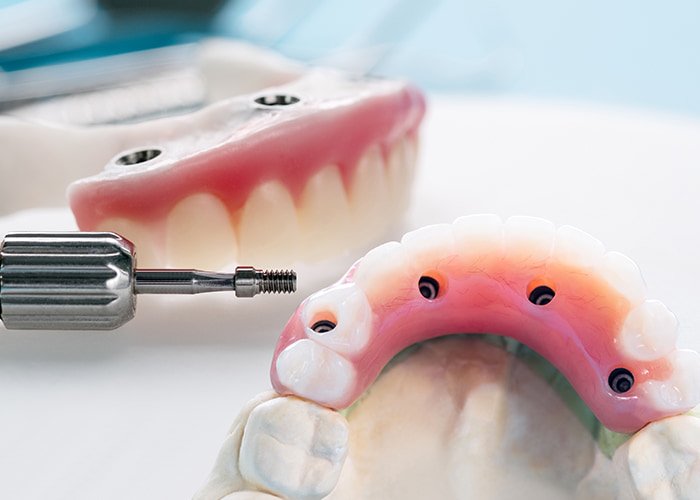
Overdentures attach to a bar or ball-shaped supports to hold them in place. However, most of the pressure exerted by the denture is still borne by the gums. This type of attachment means that the denture is held in place by the implants rather than being fixed to them.
You will need from two to four implants for an overdenture. The implants keep the overdenture from slipping or moving during eating or talking.
As such, overdentures are more comfortable than conventional removable dentures for most patients. Overdentures can’t provide the same chewing power as fixed full-arch prostheses, such as All-on-4.
4. Full-Arch Dental Implants (All-on-4, All-on-6, 3-on-6)
The three most popular types of full-mouth dental implants today are All-on-4, All-on-6, and 3-on-6. They differ in multiple aspects, as summarised below:
| Key factors | All-on-4 | All-on-6 | 3-on-6 |
|---|---|---|---|
| Prosthesis | Fixed full-arch prosthesis | Fixed full-arch prosthesis | 3 Fixed bridges |
| Cost | Budget | Mid-range | Premium |
| Indications | High bone loss | Moderate bone loss | Minimal bone loss |
| Number of implants | 4 | 6 | 6 |
All-on-4 Dental Implants
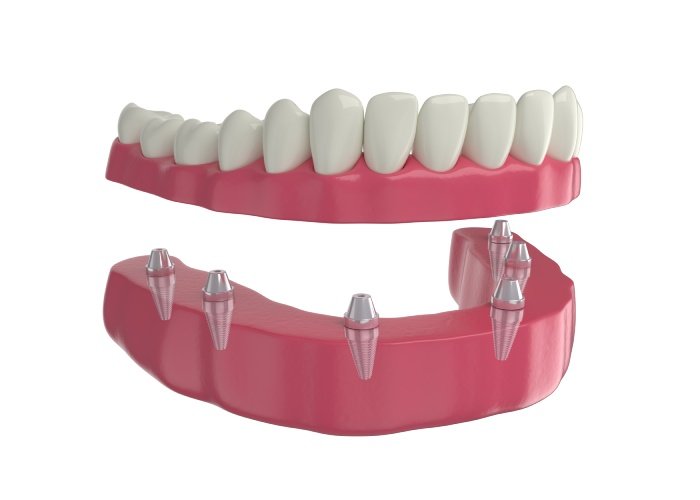
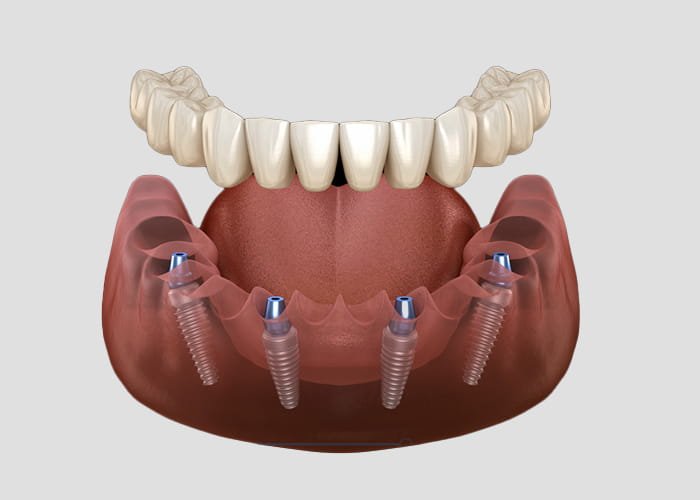
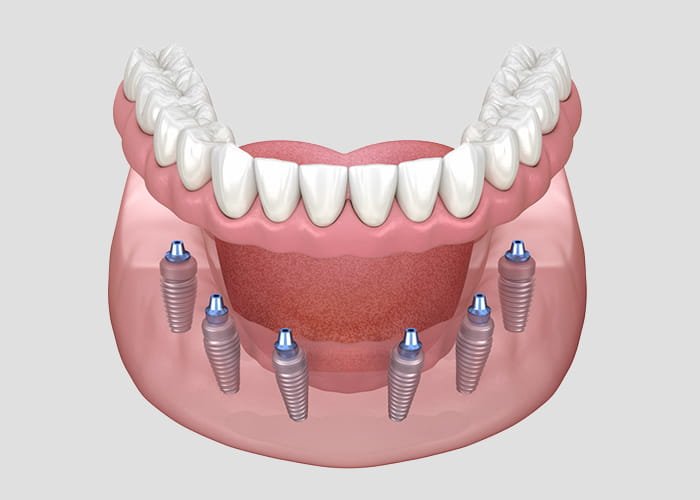
All-on-4 dental implant systems use four implant screws per arch. The artificial teeth consist of a one-piece full-arch bridge with a pink, prosthetic gum flange (border) to compensate for bone loss. The two rear implant screws are installed at an angle to avoid sinuses and nerve canals.
All-on-4 does not require bone of such high quality as other implants. The low number of implant screws also makes them more affordable.
All-on-6 Dental Implants
All-on-6 dental implants use six screws per jawbone for a full-arch bridge. The dental bridge is similar to that used in the All-on-4 system.
Installing six implant screws per jaw places a higher requirement on bone quality. The system is also more expensive than All-on-4. However, it can be preferable for eligible patients.
Using six implant screws increases long-term stability and helps to distribute pressure evenly.
3-on-6 Dental Implants
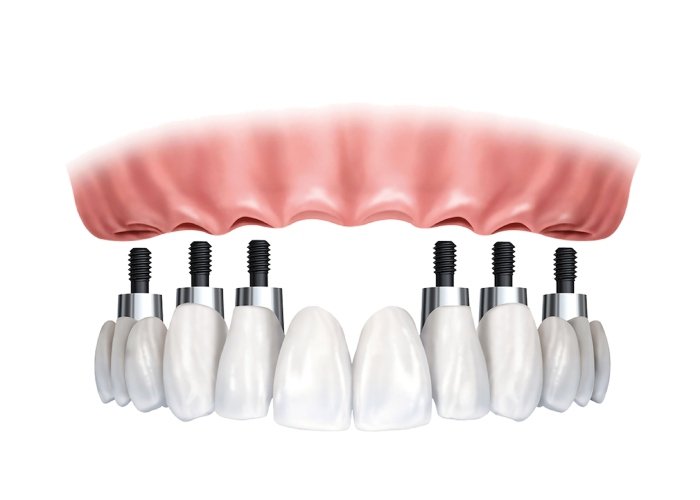
3-on-6 dental implants restore all teeth in a jaw using three separate bridge segments. Two implant screws support each segment on either side.
These bridges do not use a gum-shaped prosthetic, making them more similar to natural teeth in use and appearance. This means that the patient should have exceptional jawbone quality to be eligible.
3-on-6 implants offer good pressure distribution. Each separate bridge can be better adapted to the area in which it is installed.
Implant Size, Design, and Loading Protocols
Implant screws are available in various sizes and forms. Understanding the differences between these factors will enable you to estimate which type is the most suitable for your case.
Standard vs Mini and Narrow-Diameter Implants
Narrow-diameter implants
Use cases:
- Narrow jawbone
- Permanent replacement of teeth with thin roots
Standard endosteal (screw-like) dental implants are available in narrow, regular, and wide diameters. These are not separate types of dental implants, but simply different sizes.
The dentist will select among them based on the jawbone thickness and tooth size. The goal is to use proportionally-sized implant screws.
Mini implants
Use cases:
- Retaining overdentures
- Temporary support
Mini dental implants are fundamentally different and have separate indications. They are one-piece screws with a ball-ended top.
Mini implants do not use separate abutments and can be very thin. Although they are less expensive than standard implants, they are not as long-lasting.
Their structure and size make them appropriate only for specific uses. As such, mini implants are not a direct alternative to a standard screw-type implant.
Mini implants are best used for low-load prostheses or stabilising overdentures, rather than for long-term single-tooth restorations.
| Narrow-diameter implants | Mini implants |
|---|---|
| A smaller conventional endosteal implant | A separate type of implant |
| Typically two-piece (separate screw and abutment) | One-piece screw with ball-ended top |
| Used for permanent tooth replacement | Used for retaining overdentures or low-load prostheses |
| Long service life | Shorter service life |
Immediate-Loading vs Two-Stage Dental Implants
In the past, socket preparation, implant screw placement, prosthesis loading, and other stages of implant treatment were all separate procedures conducted weeks apart. This protocol for installing traditional dental implants can now be shortened.
In some cases, the immediate-loading protocol can be used to install same-day dental implants. The patient receives temporary teeth almost immediately after the dentist installs the implant screw. It helps save time and gives immediate aesthetic results.
Immediate implants are best used when:
- The patient has high jawbone quality and stability
- Installing stable systems, such as full-arch bridges
- Immediate aesthetic appearance is of great importance.
This protocol cannot be used if you need an extensive bone graft or other type of major augmentation. It also requires extensive planning to minimise risks.
With two-stage dental implants, crowns or bridges are placed after healing is complete. Although it requires a waiting period for the patient, it can be used in more patients and is easier to plan. This has made them the standard type of implant today.
Note that implant healing time and the treatment timeline are highly dependent on oral health circumstances.
Implant timeline comparison
Immediate-loading implants
- Implant installation surgery
- Temporary teeth (same day or within a week)
- Recovery (3-6 months)
- Permanent teeth
Two-stage implants
- Implant installation surgery
- Recovery period (3-6 months)
- Minor surgery to uncover implants
- Permanent teeth
Implant Materials and Design Types
One of the most important factors to consider when choosing an implant is the material and design of the implant screw. These affect the final appearance of the implant system, tissue stability, and healing.
Titanium vs Zirconia Dental Implants
Titanium and zirconia are the two primary materials for dental implants.
Titanium implants:
- Durable and biocompatible
- Long history of use
- Suitable for all dental prostheses
- Possible ‘grey shine’ or metal sensitivity
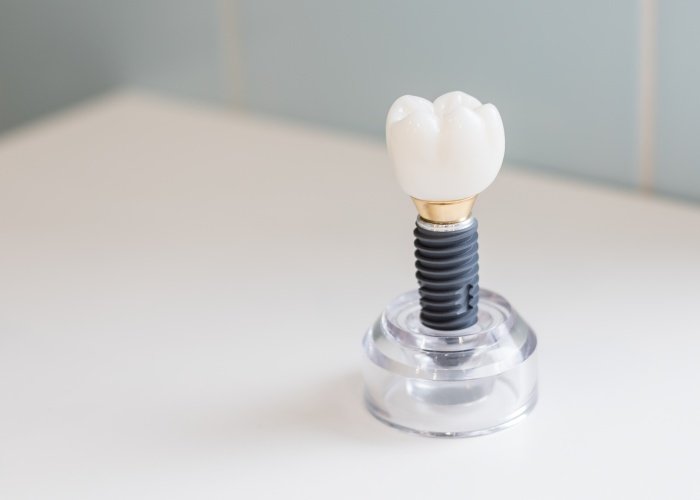
Titanium dental implants are the most widely used. They are made from medical-grade titanium. They are highly biocompatible, stable, and have a proven history of reliability. Titanium fixtures can be used for implant systems of any scale.
A possible aesthetic drawback of titanium screws is that they can become visible if the patient’s gums are thin. Some patients are sensitive to specific titanium alloys used in dentistry.
Zirconia implants:
- Hypoallergenic ceramic material
- Exceptional aesthetics
- Less established material
- Limited availability
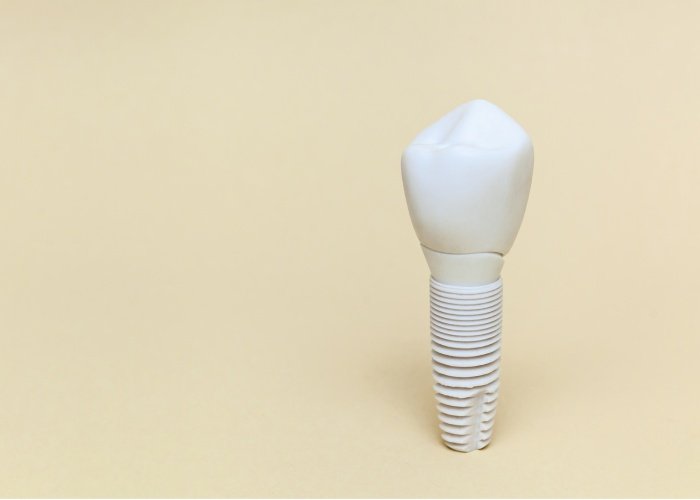
Zirconia dental implants are made from white ceramic material. They offer a more natural appearance when installed in patients with thin gums and are completely hypoallergenic. They are less common and tend to cost more. Additionally, they have a slightly lower success rate.
Zirconia implants deliver exceptional results when used to replace front teeth, where aesthetics are of major concern.
One-Piece vs Two-Piece Implants
Depending on whether the abutment (the connecting piece) is separate or integrated into the implant screw, implants can be one-piece or two-piece.
One-piece implants:
- Abutment and screw as a single unit
- Can’t adjust the angle after installation
- Improved screw–abutment stability
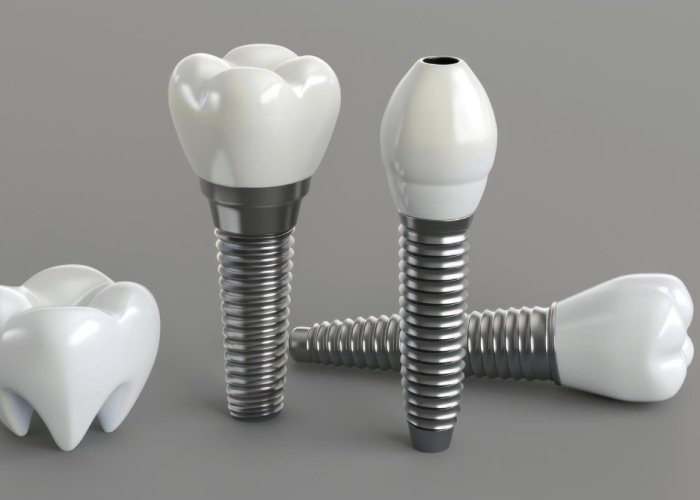
One-piece implants have the abutment and the screw as a single unit. They are faster to install, but less flexible.
Careful treatment planning is required, since adjusting the angle of the prosthesis is difficult after the implant screw is installed. The absence of a micro-cavities in the implant body reduces the risk of infection and improves stability.
Two-piece implants:
- Screw and abutment are separate
- Allow for adjustments post-installation
- Screw-abutment connection may loosen over the years
In two-piece implants, the implant screw and the abutment are separate. The abutment is screwed into the implant body. This offers greater flexibility, allowing dentists to adjust the angle of the artificial tooth without having to remove the implant.
The micro-gap between the implant body and abutment means the system is slightly less stable than a one-piece implant, which has a monolithic design.
Bone-Level vs Tissue-Level and Connection Types
The screws of bone-level implants are recessed into the socket after installation, and remain at or slightly deeper than the jawbone level. This allows the artificial teeth to extend further into the gums.
Since they offer greater flexibility when shaping the gums, they can give better aesthetic results. This type of implant usually requires a secondary surgery to expose the screws after healing.
Tissue-level implants extend further into the mouth, ending at the level of the gum margin or a few millimetres deeper.
Since the gums heal around the implant collar, no additional surgical ‘exposure’ is necessary. However, extra care must be taken during treatment planning and placement to ensure that the implant screws are not visible through the thin gum tissue.
Connection Types
Implant screws can have an external or internal connection. This is the area where the artificial tooth is attached to the screw.
The external attachment extends beyond the body of the screw. The internal connection sits within the screw. Most implants today use an internal connection, as it is less prone to loosening.
Dental implant systems offered by established manufacturers provide implants that are compatible with bone and tissue. This allows for the use of the same surgical instruments and similar application protocols. The dentist should use an established implant system to simplify the surgery and improve treatment outcomes.
Dental Implants vs Other Tooth Replacement Options
Dental implants are not the only method of replacing missing teeth. Conventional bridges and dentures are among the most popular, but they lack the unique advantages of dental implants
Implants and Alternatives Comparison
| Key factors | Implants | Bridge | Dentures |
|---|---|---|---|
| Comfort | Exceptional | High | Variable |
| Bone preservation | Prevents bone loss | Doesn’t stop bone loss | Doesn’t stop bone loss |
| Longevity | 20+ years | 10-15 years | 5-8 years |
| Maintenance | Simple (Similar to natural teeth) | Moderate (special flossing required) | High (Daily removal and soaking) |
Reputable dental clinics achieve much higher success rates in implant treatments. They use appropriate implant placement methods and materials. This helps avoid postoperative side effects, shorten recovery time, and ensure your new smile is aesthetically pleasing.
Dental Implants vs Dental Bridges
Conventional dental bridges are dental replacements that restore the crown of a missing tooth but do not replace its root. Bridges can be used when the patient has very low bone density or other conditions that make dental implants inadvisable. Bridges need healthy teeth to anchor to, which are irreversibly modified during installation.
Unlike implants, they do not stop bone loss at the location of a missing tooth. The fact that the replacement tooth rests on the gums makes bridges less stable than implants, and their service life is thus shorter.
Dental Implants vs Removable Dentures
Traditional removable dentures are supported only by the gums and a vacuum suction. They can be used irrespective of jawbone quality and are less expensive than implants.
The main difference between dental implants and dentures for patients is comfort. Dentures can move in the mouth if the patient is not careful, and it takes time to get used to wearing them.
Removable dentures cannot support the full bite pressure. This limits what types of food a patient can eat. They also do not stop bone resorption, thus they can’t prevent the changes in jaw structure over time.
However, dentures do not require surgery and so can be worn by almost every patient with edentulism (tooth loss).
When Implants Are Not Recommended
Dental implant installation is a surgery and is unsuitable for patients who can’t undergo surgical treatments because of certain health conditions, such as those listed below:
- Uncontrolled diabetes
- Untreated gum disease
- Autoimmune diseases
Common teeth replacement options include removable dentures and traditional bridges. If there are limitations related to the jawbone structure, some patients may be able to have implants placed after bone or gum augmentation surgery.
How Implant Type Affects Cost and Treatment Plan
Since implants vary in size and complexity, there are vast price differences between different types. The final treatment costs always depend on the patient’s individual case. Nonetheless, the average price for implant treatment does correlate directly with the type of implant.
Cost Differences Between Major Implant Types
The primary factors influencing cost differences between dental implant types are the implant’s position in the jaw and the scope of the required treatment. To better understand these differences, you may wish to check the current dental implant costs in Turkey.
Single vs. Multiple Tooth Restoration
Restoring a single tooth is almost always cheaper than placing an implant-supported bridge. However, when multiple teeth need replacement, fixed bridges and overdentures are more economical than placing an implant screw for each missing tooth. Compare:
- Single-tooth implant: Consists of a single implant screw, abutment, and a crown. Replaces one tooth.
Average cost: £370 – £880 (depends on the brand)
- Full-arch fixed bridge: A large prosthesis using four to six implant screws. Replaces 10-14 teeth
Average cost: £2,400 – £9,600
Although the cost of a full-arch treatment is higher, it is more efficient in terms of cost per tooth replaced.
Restoration complexity
Treatments that require more careful planning and experience from the dentist are more expensive.
- Zygomatic implant: A full-arch bridge for patients with severe bone loss.
Average cost: £2,000 – £5,000
A zygomatic implant system and a regular full-arch implant are similar in look and feel when installed in eligible patients. The zygoma implant is more expensive due to its complexity. Its use is recommended for patients who can’t receive a less complex system.
Similarly, other complex cases involving major bone loss are more expensive.
- Mini implant: A simpler one-piece implant screw that is simple to install.
Average cost: £250 – £550
While less expensive than traditional implants, mini implants can only be used in specific cases, such as stabilising an overdenture, and are less suitable for full-load artificial teeth.
Additional Procedures and Their Impact on Price
Bone and tissue augmentation are additional procedures that many dental implant candidates require. As a result, the cost of dental implants for patients with bone loss tends to be higher.
Any major augmentation procedure increases the treatment time and raises its cost. This includes major bone grafts, sinus lifts, and ridge augmentations.
Patients should consult the dentist and carefully consider whether they should undergo a major augmentation or use an implant system that can be installed without it.
For example, the All-on-4 implant system requires less jawbone reconstruction than the 3-on-6 system for patients with major bone loss.
Using an implant system that requires fewer additional procedures can help save money and make treatment outcomes more predictable.
How to Choose the Right Type of Dental Implant for You
Multiple factors should be considered before determining which type of dental implant is best suited for your case. These include the number of teeth to be restored, the jawbone health, your overall oral health, and budget constraints.
There are numerous dental implant options available. While you can narrow down your options based on the number of missing teeth, a dentist can help evaluate:
- Bone density: To choose a stable implant.
- Bite alignment: To determine the best type of artificial teeth.
- Gum health: To prevent infections after surgery.
Online articles can help you learn about the available options. However, you should make your final decision after consulting with a specialist. During a clinical examination, the dentist will perform a detailed examination using X-rays and CT scans. This will help determine the most suitable implant option for you.
Implant Treatment Steps
- Consultation
- 3D Planning
- Surgery
- Restoration
Scheduling a consultation is the essential first step towards the best aesthetic and functional results. Promptly addressing tooth loss will help preserve the remaining teeth and jawbone integrity, enabling you to achieve better treatment outcomes.

Frequently Asked Questions About Types of Dental Implants
What are the 4 types of dental implants?
Implant systems are most commonly divided by scope into single-tooth implants, fixed bridges, implant-retained overdentures, and full-arch bridges.
What are screw-in teeth called?
Implants that use a screw-like fixture are known as endosteal implants.
What implants are the best for full-mouth restoration?
Restoring all missing teeth with full dental implants can be done with a full-arch implant-supported bridge or implant-retained overdentures.
Are mini dental implants a good long-term solution?
Mini dental implants are mostly used to retain overdentures in the short term. Their long-term success will depend on your individual case
Are all types of implants a permanent replacement for missing teeth?
All types of implants can only be installed in place of a missing or extracted tooth. Implants can be considered permanent since they fuse with the jawbone. With good care, most implant fixtures (roots) can last a lifetime.