+90 534 226 60 59
  Mon - Fri: 9:00-18:00; Sat: 9:00-17:30; Sunday: Closed

The choice between full dentures and partial dentures depends on the number of missing teeth and treatment goals. Which type of denture is suitable for the patient often depends on the condition of remaining teeth and the results of dental assessment.
This article compares full and partial dentures to help you better understand their main differences and why one or the other might be recommended. You can learn more about dental denture treatments in general in our “Types of dentures” article.
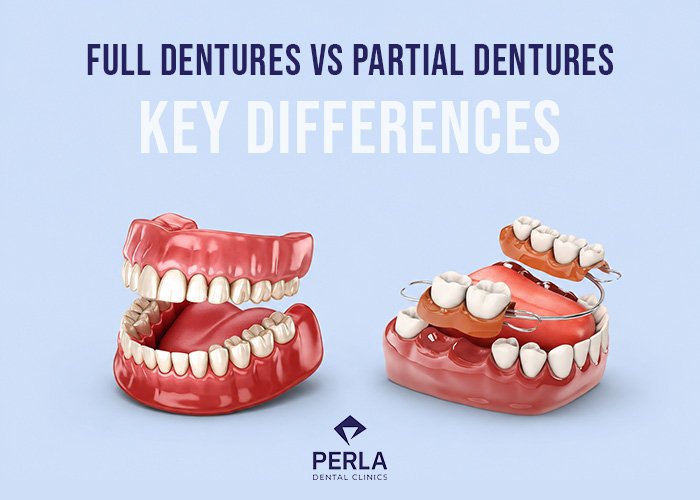
Table of Contents
What Is the Difference Between Full and Partial Dentures?
Full and partial dentures differ in the number of teeth they replace. Full dentures replace every tooth in a dental arch. Partial dentures replace one or more missing teeth while leaving intact natural teeth in place.
These denture options solve different clinical problems. Depending on how many viable teeth the patient has left, the dentist may advise a complete or partial denture.
- Full Dentures replace every tooth in a dental arch.
- Partial Dentures replace only some teeth, leaving intact natural teeth in place.
What Are Full Dentures?
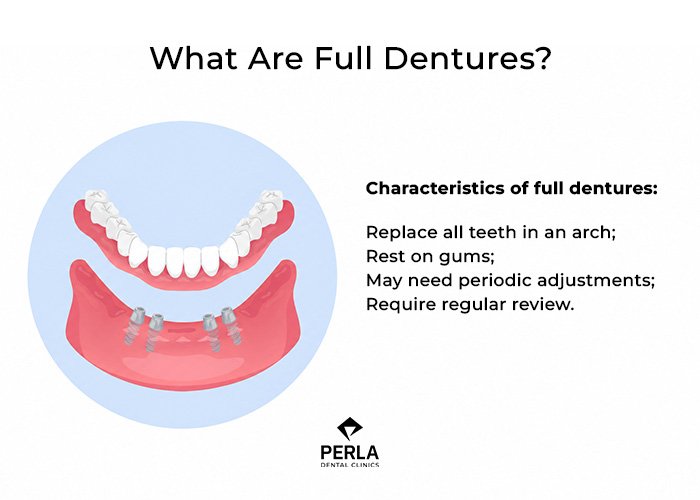
Full dentures are removable dental restorations used when the patient has no or only a few functioning teeth in one or both jaws. They may also be called complete dentures.
Full dentures may be retained by resting on the gums, relying on friction and suction to stay in place. The dentist will take dental impressions or scans and perform try-ins of the full denture to ensure a good fit and enable the patient to chew and speak with the dentures in place. However, due to continuous jawbone shrinkage and wear, dentures may require adjustments over time.
What Are Partial Dentures?
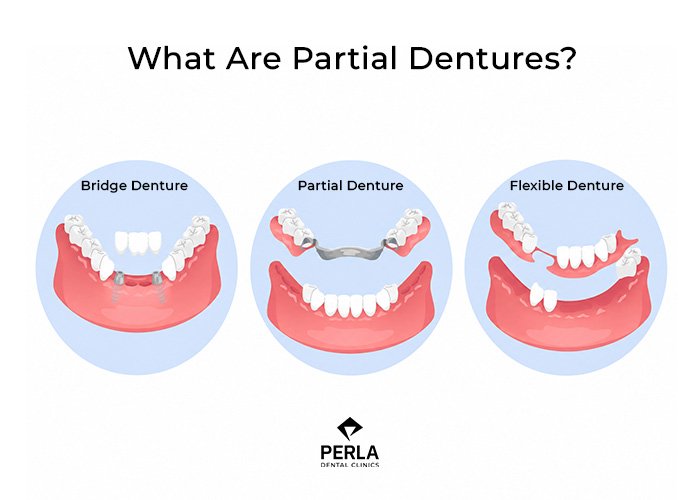
Partial dentures are removable restorations that replace one or more teeth, leaving the rest of the intact teeth in place. They may use both gums and remaining teeth for support, commonly using clasps or other attachment methods.
The design and materials for partial dentures vary widely and may use plastic, nylon, or metal elements. The dentist will be able to recommend a suitable type of partial denture for your case after a dental examination.
Partial dentures can replace one tooth, multiple teeth, or several gaps, depending on the patient’s case and oral health.
Full Dentures vs Partial Dentures: Quick Comparison
Full dentures and partial dentures differ in the number of teeth they replace, support, potential fit and comfort, and other factors. You can learn more about the main differences between denture types below. However, the final choice between full and partial dentures should depend on the results of a dental examination.
| Factor | Full denture | Partial denture |
|---|---|---|
| Usually considered when | The patient has few to no viable teeth left in the arch. | The patient has some or most of their teeth left. |
| Stability | May feel less stable for some patients. | May feel more stable for some patients. |
| Replaces | All teeth in a dental arch. | One or more teeth. |
| Supported by | Mostly gums or the palate. | Gums and clasps, or other connection options. |
Fit, Stability and Retention
Full and partial dentures can feel different because they can use different retention methods. Many full dentures rely only on the gums or palate for support, though they may sometimes use dental adhesive or be retained on implants.
Partial dentures may use the remaining teeth for support, attaching to them via clasps or other types of frameworks. This can make partial dentures feel more stable for some patients.
The treatment process for both full and partial dentures involves extensive examinations and try-ins to achieve a suitable level of stability.
Factors determining denture stability include:
- Fit;
- Gum shape;
- Remaining teeth;
- Bite;
- Following cleaning recommendations;
- Review appointments.
Comfort, Appearance and Daily Function
How comfortable dentures are to wear depends highly on their design and the patient’s jaw and gum condition. Fit, materials, and the patient’s bite influence whether eating or speaking with dentures feels natural and how long it takes to adjust to wearing them.
Dentures require an adjustment period during which the patient learns how to wear them in their daily life. During this time, dentures can feel less comfortable. As the patient adjusts to their dental restorations, speaking and eating while wearing the dentures should become easier.
Dentures’ comfort and suitability may be judged by:
- How they look;
- Ease of eating with them;
- Ease of speaking with them;
- Whether the patient feels confident wearing them;
- How long it takes to adjust to wearing them.
Cleaning and Maintenance
Both full and partial dentures require daily cleaning and regular review appointments for optimal results. The dental clinic will provide denture maintenance advice based on the patient’s case and denture type.
For partial dentures, keeping the remaining healthy teeth and gums in good condition is very important, as they provide support. Losing the supporting teeth can make the denture unsuitable for further wearing.
General denture care recommendations:
- Clean your dentures daily;
- Remove them as advised by the dentist;
- Protect remaining teeth from damage and decay;
- Regularly attend denture reviews;
- Report soreness or denture looseness to the dentist.
How to Know If You Need Full or Partial Dentures
The choice between partial and full dentures is based on several factors:
- Number of missing teeth;
- Condition of intact teeth;
- Gum health;
- Available jawbone support;
- Patient’s bite;
- Comfort expectations;
- Preferred budget.
Full dentures may be preferred when the patient’s remaining teeth, if any, cannot reliably support a partial denture or a dental bridge.
Partial dentures may be used if the patient has teeth that can support the restoration. Whether the patient’s remaining teeth can be preserved depends on the results of a dental check-up.
How Do Full and Partial Denture Costs Compare?
The cost of full dentures and partial dentures can vary depending on procedure scale and complexity. Price factors for dentures in Turkey include:
- Number of missing teeth;
- Denture material;
- Denture design;
- Fitting complexity;
- Need for adjustments;
- Repairs;
- Travel expenses;
- Aftercare procedures and guidance.
Both full and partial dentures take three to five appointments to manufacture and fit. These appointments are usually done over three to five weeks. As such, they may not be available for international patients in some clinics, including Perla Dental Clinics. Cosmetic dentures in Turkey usually cost between £300 and £750 and have a 3-year warranty.
Alternatives to Full and Partial Dentures
Common alternatives to full and partial dentures include implant-retained dentures, implant-supported dentures, palateless dentures, and dental bridges.
These alternative treatments are planned and performed differently from common removable full and partial dentures. Implant-retained dentures are removable and use implants for stability. Implant-supported dentures are not removable.
Palateless dentures are used for the upper dental arch and do not cover the roof of the patient’s mouth. This type of denture may also use implants for support.
Dental bridges are fixed prostheses that use natural teeth for support. Patient suitability for bridges and implant-supported or retained dentures requires separate assessment, and not every patient who is eligible for removable fixed or partial dentures may be eligible for these alternatives.
Planning Denture Treatment in Turkey
International patients who want to get dentures in Turkey should ensure the clinic offers such treatments for foreign patients first. If the treatment is not available, an alternative, such as bridges, may be suitable for the patient’s case.
This can be established during a remote consultation and assessment. During or shortly after the online consultation, you should:
- Provide dental photos or scans, if requested;
- Receive your personal treatment plan and itemised quote in written form;
- Confirm the material and design of the dental restoration;
- Clarify follow-up and aftercare protocol for the dental treatment;
- Receive contact details for post-treatment questions.
A written quote and treatment plan are very important for UK patients, since they confirm the expected treatment price and the actual procedures and restorations you are to receive.

Medically reviewed by:
Dr. Onur Ademhan
Oral and Maxillofacial Surgeon
Founder and CEO of Perla Dental Clinics. Graduated from Ankara University Faculty of Dentistry and specialized in Oral and Maxillofacial Surgery at Gazi University.
Frequently Asked Questions About Full and Partial Dentures
Are Partial Dentures Better Than Full Dentures?
Which type of denture is better for your case depends on the results of dental assessment. Both full and partial dentures have their use cases. Which restoration is more suitable for you can depend on the number of remaining teeth, jawbone health, and other factors.
Are Partial Dentures Comfortable?
Partial denture comfort depends on fit, design, and how easy it is for the patient to adjust to wearing their dentures. In some cases, dentures may require additional adjustments for optimal comfort. In rare cases, a patient may be unable to adapt to wearing a removable denture. In this case, a fixed alternative may be preferred.
Do Partial Dentures Look Natural?
Partial dentures are made to resemble the surrounding natural teeth. However, their final appearance depends on design, materials, and fit. As such, actual results may vary, especially for complex cases.
Can You Get Partial Dentures for Back Teeth or Molars?
Partial dentures may be discussed as a replacement for posterior teeth or molars. Whether the patient can restore these teeth with partial dentures depends on their bite and needs. If the patient requires a very durable and stable restoration, alternative treatments may be considered.
How Long Do Full and Partial Dentures Last?
The lifespan of removable dentures can vary depending on the patient’s case, bite, fit, and other factors. Good care, regular reviews and adjustments are essential for optimal denture service life. A dentist can provide a realistic lifespan estimate after evaluating your oral health.
What Is a Stayplate vs a Partial Denture?
Partial dentures are intended for long-term use. A stayplate is a temporary removable restoration used while the patient waits for another tooth replacement. A stayplate may be discussed as part of a broader treatment, but is not intended as a final prosthesis.