+90 534 226 60 59
  Mon - Fri: 9:00-18:00; Sat: 9:00-17:30; Sunday: Closed

Implant-supported and implant-retained dentures both treat total or near-total tooth loss in a jaw, but are not the same. These two types of dentures differ in what provides their primary support, stability, average number of implants, bone requirements, maintenance, and average cost.
This article will help you better understand how clinical case or personal preference can influence the choice of implant-supported vs implant-retained dentures, and why your dentist may recommend one restoration over the other.
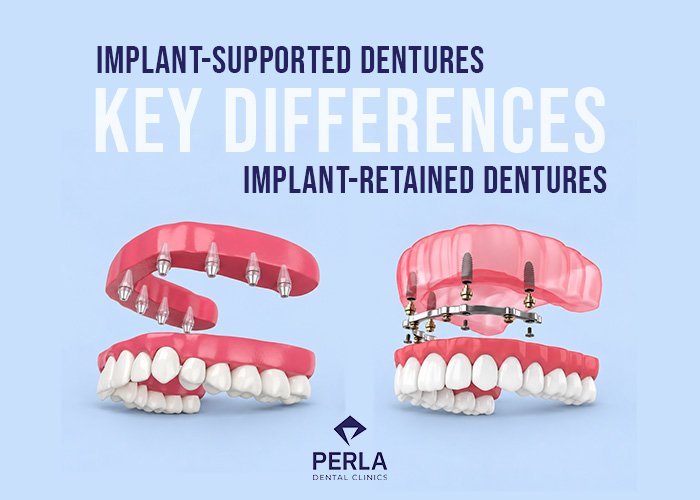
Table of Contents
Implant-Supported vs Implant-Retained Dentures: Quick Comparison
The primary difference between implant-supported and implant-retained dentures is in the role of implants. In implant-supported dentures, the implants support the entire prosthesis and absorb chewing forces. In implant-retained dentures, implants prevent the prosthesis from shifting, but soft tissues provide the primary support, like in traditional restorations. You can compare the differences between both types of treatments below:
| Criterion | Implant-Supported | Implant-Retained |
|---|---|---|
| Support and Retention | Support and retention by implants only | Retained by implants, supported primarily by the soft tissues |
| Fixed/Removable | May be fixed or removable | Removable |
| Stability | Higher stability; there should be no movement of the prosthesis | Moderate stability; possible micro-movement under load. |
| Number of Implants | Four or more | Two or more |
| Bone Requirements | Higher requirements | Generally lower requirements |
| Cleaning | Can be more complex; requires cleaning under the prosthesis. | Usually simpler; prosthesis can be removed for cleaning. |
| Maintenance | Usually less frequent, but adjustments may be more complex | Usually more frequent, mostly for routine attachment replacement |
| Cost | Usually more expensive | Can be less expensive |
| Best Suited For | Patients seeking stronger bite forces with minimal prosthetic movement | Patients preferring a more stable alternative to traditional dentures |
Support and Retention
Support and retention are related, but different terms. A dental prosthesis may have different primary sources of retention and support. Implant dentures are divided based on the role the implants play in the system.
What Does “Supported” vs “Retained” Mean?
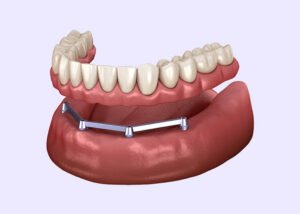
“Implant-retained” means that implants are used primarily to keep the prosthesis from shifting or falling out of the patient’s mouth. Vertical support is provided mostly by the oral mucosa and alveolar ridge, on which the prosthesis rests during use. This limits the patient’s ability to use their full chewing force, similar to traditional prostheses.
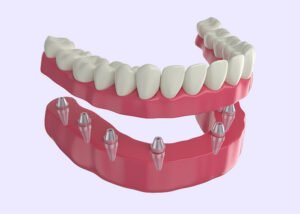
“Implant-supported” means that the denture receives all of its support from implants, which are directly connected to the jawbone. As a result, all chewing forces are transmitted directly into the bone, as with natural teeth.
Fixed and Removable Design
Fixed and removable implant dentures differ in whether the prosthesis, also called artificial teeth, can be removed by the patient. Implant-retained dentures are removable, while implant-supported dentures are often, but not necessarily, fixed.
Removable and fixed dentures can use different connectors to attach to implants, chosen based on the system type and the patient’s needs.
Implant-retained dentures are removable. Their load-bearing support comes from soft tissues, so they require some vertical movement, precluding fixed designs.
The terms “implant-supported” and “implant-retained” refer specifically to the role of implants in the system, not the patient’s ability to remove the prosthesis.
Are Implant-Supported Dentures Always Fixed, and Are Implant-Retained Dentures Removable?
No, implant-supported dentures can be both fixed and removable. While removable implant-supported overdentures are less common, there are options available, such as those using a rigid bar framework. A typical fixed full-arch implant-supported solution is a fixed All-on-4 implant bridge.
Stability, Comfort and Chewing
The average stability of a dental prosthesis is different for implant-supported and implant-retained dentures. This largely depends on how the prosthesis, gums, and jawbone react to occlusal forces, which appear when the patient bites or chews.
In implant-retained dentures, implants limit prosthesis movement, stopping it from slipping or shifting. In implant-supported dentures, implants eliminate prosthesis movement, fixing it rigidly in place.
As such, patients may find it easier to chew with implant-supported dentures, since they allow them to use more of their biting force.
In terms of comfort, a systematic review of patient satisfaction with implant overdentures reports higher patient satisfaction and quality of life when using implant overdentures, compared to traditional dentures.
How Many Implants Are Needed?
There is no single number of implants required for every type of implant denture. The number of implants required depends on the patient’s clinical case, needs, treated jaw, bone density and dimensions, and denture type.
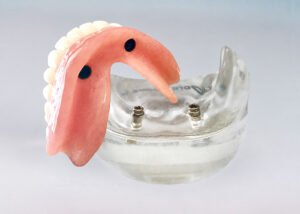
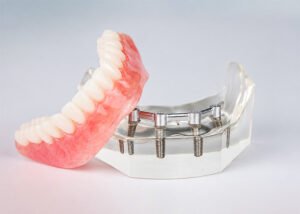
While the precise number of implants can vary, certain limitations determine the minimal possible number of implants for dentures. Mandibular (lower jaw) implant-retained overdentures may use two implants in some cases. All other types of implant dentures typically require at least four implants.
Implant-supported restorations usually require more implants, because the implants in these systems should absorb most chewing forces. Implant-retained dentures, in which the implants are not subject to such forces, may use fewer implants in comparable clinical cases.
Using more implants generally leads to better pressure distribution. As such, patients with greater bite forces may prefer solutions with more implants, if their placement is possible. An All-on-6 system is an example of a six-implant full-arch treatment.
Bone Requirements: Which Option Needs More Jawbone?
Jawbone requirements for implant-supported dentures are usually higher. Implant denture bone requirements increase with the number of implants and the amount of force they are expected to support during regular use.
Patients with reduced bone volume may require a bone graft before or during implant surgery. In some cases, implant-retained dentures may be used for such patients without a bone graft, but this is highly case-dependent.
A CBCT examination is required to determine the patient’s jawbone condition, optimal implant positions and the need for a bone graft.
Procedure and Recovery
Implant-supported and implant-retained denture procedures use similar treatment stages, but differ in some details. Both types of treatments begin with a consultation and dental examination. The patient may also require pre-surgery procedures, such as extracting remaining teeth.
The surgical stage for implant placement is similar for both types of dentures, but the rationale for choosing it can differ between denture types.
For some implant-retained dentures, the dentist may choose areas with suitable bone condition for the implants, since they would be under lower pressures.
Implant sites are more specific for implant-supported dentures, so a bone graft may be required when the optimal location lacks necessary bone density.
For implant-retained dentures, the implants may be left to heal under the gums, while the patient wears a temporary removable denture. In implant-supported denture treatments, the dentist may place a temporary prosthesis shortly after surgery.
Recovery and osseointegration timelines are similar for both types of dentures and depend on the patient’s general health and the original bone condition.
The prosthesis manufacturing and fitting stages differ, as implant-supported prostheses are typically more complex. In both cases, the final prosthesis is manufactured and fitted only after the implants have completed osseointegration.
The prosthesis adaptation period and total treatment time vary by case. Patients who want to get implant dentures in Turkey should confirm the treatment plan before travelling.
Maintenance and Lifespan
Implant denture system’s components have different lifespans. The implants, prosthesis, and attachments wear down at different rates, which determines how often the patient needs maintenance visits to a dental clinic.
Attachments generally have the shortest lifespan, while the prostheses can serve longer. Implants usually have the longest total service life.
Maintenance routine for fixed and removable prostheses can also differ. Removable prostheses can be removed for cleaning and should not be worn during sleep. In fixed systems, the patient needs to clean under the prosthesis, possibly using special toothbrushes and floss.
Implant overdenture maintenance may also involve replacing inserts. In particular, removable overdentures require routine nylon insert replacement as part of periodic in-clinic maintenance. A systematic review of Locator overdenture maintenance shows that frequent dentist visits are required for optimal function.
| Component | Typical Maintenance |
|---|---|
| Implants | Regular clinical checks. |
| Removable prosthesis | Professional cleaning, relining, and repair. |
| Attachments | Planned replacement as attachments wear. |
| Fixed prosthesis | Professional component maintenance. |
Cost and Long-Term Value
Implant-supported and implant-retained dentures costs depend on the implant system, case complexity, and number of implants. Implant-supported systems tend to be more expensive, since they usually require more implants and a more complex treatment plan.
When comparing implant systems, patients should consider not only the initial costs, but also maintenance expenses. For example, a cheaper implant-retained denture may require more frequent maintenance for some patients, lowering its long-term value.
Additionally, both implant-retained and implant-supported dentures can be made of different materials, which affects the cost, appearance, and durability of the restoration.
Cost of Implant-Supported vs Implant-Retained Dentures in Turkey and the UK
Implant denture costs in Turkey and the UK can be different for the same type and quality of treatment. Dental treatment in Turkey can also help patients avoid long wait times and offer a wider choice of restoration types and materials.
For a more comprehensive cost comparison between countries, include the total cost of all necessary procedures, travel expenses, aftercare, and warranty policy offered for the treatment.
Risks and Complications
Implant overdenture complications can be biological and prosthetic in nature. Biological complications relate to negative changes in the patient’s oral or general health. Prosthetic complications relate to negative changes in the restoration itself.
Biological complications for both implant-retained and implant-supported dentures include peri-implantitis, peri-implant mucositis, and osseointegration failure.
Implant-retained denture issues include attachment wear and prosthetic instability. A systematic review of implant overdenture attachment systems has shown that locator attachments have the lowest chance of complications, followed by telescopic, conus, bar, and ball attachments.
Implant-supported denture complications can involve prosthetic screw loosening, screw or prosthesis fracture, and plaque accumulation under the fixed bridge.
Professional cleaning and dental check-ups are very important to prevent such issues. Patients also need to follow a specialised oral hygiene regimen adapted to the type of restoration. The dentist typically provides these recommendations after the procedure.
Implant and prosthesis failure are usually separate events and may be caused by entirely different factors. They usually require replacing the failed component. Loss of retention may result from issues such as screw loosening and can be reversible. Maintenance events, such as connector or denture lining replacement, are planned and are not signs of failure.
Implant-Supported or Implant-Retained Dentures: Which May Suit You Better?
Neither type of implant denture is best for all cases. Suitability depends on jawbone condition, prosthesis design, patient’s ability to maintain oral hygiene, expectations, and budget.
Implant-Supported May Suit You If…
- You prefer higher prosthesis stability;
- Your jawbone condition is suitable for the treatment;
- You can clean the prosthesis without removing it (for fixed prostheses).
Implant-Retained May Suit You If…
- You prefer a removable prosthesis;
- You prefer treatments that use fewer implants or may avoid bone grafting;
- Your budget requires a lower initial treatment cost.
Considering Implant Dentures in Turkey?
Implant dentures in Turkey can be a good choice for many cases, but require more detailed planning than treatment in your home country.
The first step is contacting the clinic for a remote consultation. The patient may need to prepare relevant dental photos, X-rays, and other types of dental imaging. The clinic will use this information to create a preliminary diagnosis and quote. During the consultation, patients should clarify the possible number of treatment stages, recovery time, and travel schedule. The clinic should create a written treatment plan and quote.
At Perla Dental Clinics, implant placement requires two visits separated by a recovery period of 3 to 6 months. Both visits usually take under a week. We provide a 10-year warranty on implants. Learn more about our fixed full-arch implant treatment in Turkey here.
Request a personal implant treatment consultation and assessment at our clinic to learn which restoration type is suitable for you, and receive your personal treatment plan and itemised quote.

Medically reviewed by:
Dr. Onur Ademhan
Oral and Maxillofacial Surgeon
Founder and CEO of Perla Dental Clinics. Graduated from Ankara University Faculty of Dentistry and specialized in Oral and Maxillofacial Surgery at Gazi University.
FAQ About Implant-Supported vs Implant-Retained Dentures
Which Is More Stable: Implant-Supported or Implant-Retained Dentures?
Generally, implant-supported dentures can offer greater stability because the way the prosthesis attaches to the implants prevents any movement. Implant-retained dentures use implants to prevent prosthesis shifting, but some micro-movements are possible, as are movements caused by soft tissue compression. Actual results depend on the patient’s case.
Are Implant-Retained Dentures Removable?
Yes, implant-retained dentures are removable. Unlike implant-supported dentures, which can use fixed or removable prostheses, implant-retained dentures use soft tissues for primary support. This means the prosthesis must be removable so the patient can clean it and the gums underneath.
How Many Implants Are Needed for Implant-Retained Dentures?
Implant-retained dentures need at least two implants for the lower jaw and at least four implants for the upper jaw. The actual number of implants depends on the patient’s needs and bone availability. Generally, a prosthesis using more implants provides better stability.
Which Option Is Better With Bone Loss?
The choice of implant dentures depends not only on the bone condition, but also on the patient’s goals. In many cases, a patient who can have an implant-supported denture only after a bone graft may instead opt for an implant-retained denture without one. However, this is not possible for all patients, and the treatment results may not be the same.
Which Type Is Easier to Clean?
Implant-retained dentures are generally regarded as easier to clean because they use removable prostheses. Implant-supported dentures with removable prostheses can also be cleaned comparably easily. Fixed designs, which require the patient to clean under the prosthesis without removing it, may be challenging for some patients.
Which Costs More: Implant-Supported or Implant-Retained Dentures?
The cost of implant dentures depends not only on their type, but also on the number of implants, prosthesis material, case complexity, and other factors. That said, on average, implant-supported dentures use more implants and are more likely to require additional procedures, which often makes them more expensive.
How Long Do Implant-Supported and Implant-Retained Dentures Last?
The service life of an implant denture varies by case. The lifespan of individual components also differs, with the denture, connectors, and the implants each having different average service lives. Proper maintenance of each component of the implant denture system and following best care practices is important to maximise these lifespans.