+90 534 226 60 59
  Mon - Fri: 9:00-18:00; Sat: 9:00-17:30; Sunday: Closed

Choosing a dental crown vs filling depends on the individual case. A filling is used for smaller damaged areas, while a crown covers a larger area of a tooth.
This Perla Dental Clinics guide will help you compare these treatments. Understanding the differences between these restorations and why they might be recommended for one’s treatment plan is especially important for UK patients seeking a filling or a dental crown in Turkey.
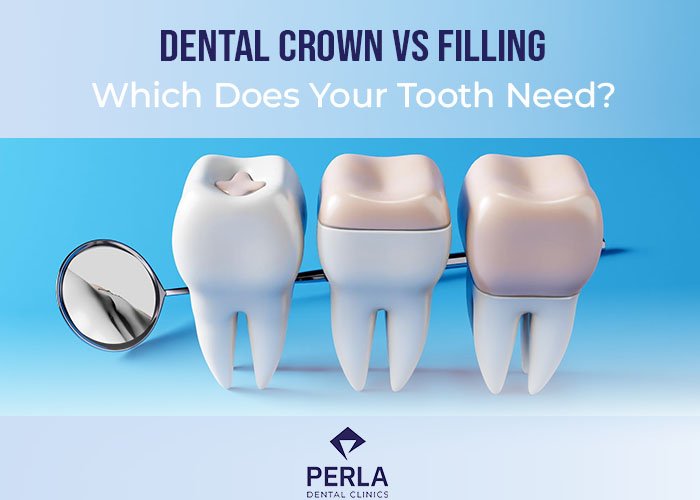
Table of Contents
Crown vs Filling: The Short Answer
Dental fillings are used for cases where the tooth has not been structurally compromised by extensive damage: chips, small or medium cavities, or to replace a failing previous filling. Dental crowns are used when more coverage is required, following a dentist’s assessment. Cases may include extensive damage or decay, large cracks, root canal treatment, severely worn-down teeth, or fixing aesthetic issues that can’t be corrected otherwise.
Choosing a filling or a crown requires a dental examination. Opting for a filling when a crown is required leaves the tooth insufficiently protected and structurally compromised, which may cause further damage or even tooth loss.
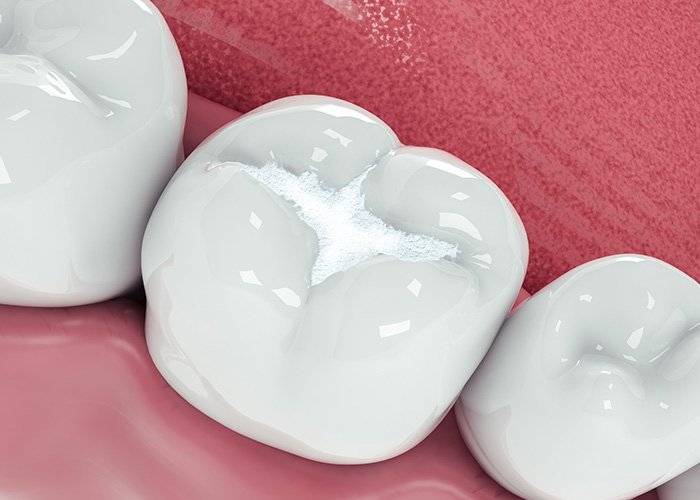
Dental Filling
For localised support for fixing minor to moderate damage and decay
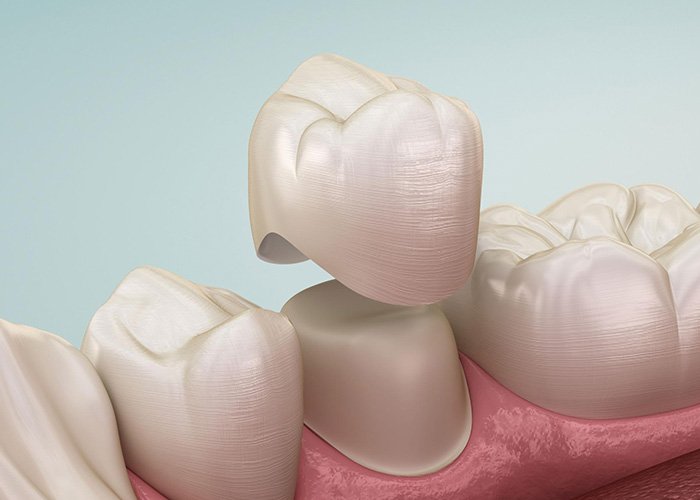
Dental Crown
For full-coverage support for extensively damaged teeth
Key Differences Between a Dental Crown and a Filling
The main differences between a filling and a crown are the extent of coverage and support they provide, as well as the amount of tooth preparation required. They are used for different cases and also differ in average cost.
| Criterion | Dental Filling | Dental Crown |
|---|---|---|
| Coverage | Fills only the damaged area | Covers the entire visible tooth surface |
| Tooth Preparation | Requires less preparation | Requires extensive preparation and tooth reduction |
| Support | Limited ability to provide structural support | Provides structural supports and redistributes biting forces on a tooth |
| Best-fit scenario | Fixing minor to medium damage | Fixing extensive damage, providing support for compromised teeth, and resolving extensive aesthetic issues |
| Cost | Lower average cost | Higher average cost |
| Treatment planning | Requires less planning and is shaped directly on a tooth | Requires more planning and is manufactured externally before placement |
Choosing a crown versus filling should be based on clinical factors. For example, restoring a minor cavity with a filling may be faster and more cost-effective, while preserving more of the natural tooth. On the other hand, extensive damage does not leave enough tooth structure intact to support a filling, and placing one in such cases can make the problem worse rather than fix it. A crown, which covers the tooth entirely, helps hold it together. It also distributes pressure across the entire tooth, not only the intact parts.
When a Filling May Be Enough
A dental filling may be preferred for cases where damage is limited. The tooth should have sufficient healthy structure to support the filling and withstand the patient’s normal biting forces.
A dentist may assess these factors before recommending a dental filling:
- Cavity size
- The extent of the damage
- How much of the healthy tooth walls remain
- How the damage impacts the patient’s bite
- Results of X-ray imaging
- Other symptoms
Fillings are most often used for small to medium cavities, small chips and superficial cracks. They are a more conservative treatment compared to crowns. The required tooth preparation is localised only to the damaged areas. This means the healthy parts of the tooth remain mostly intact.
When a Dental Crown May Be Needed
A dental crown may be used when a tooth has become structurally compromised due to extensive damage, decay, cracks, or failed large fillings. Since a dental crown covers the full outer surface of the weakened tooth, it can better protect it from further damage.
A crown may be discussed when:
- The remaining healthy tooth walls and structure are too thin to support a filling.
- The tooth has suffered extensive damage.
- The tooth had a root canal treatment, especially if it is a molar.
Whether the tooth is too damaged for a filling depends on the patient’s case and the particular tooth in question. Molars, for example, experience heavy pressure from chewing and may require a crown for longevity in cases where other teeth may be treated with fillings.
Can a Large Filling Weaken a Tooth?
For a large filling to be stable, it requires suitable support from healthy tooth tissue. In some cases, existing tooth walls and material may not be enough. Tooth preparation necessary for a large filling can also decrease structural integrity in some cases.
Large fillings can also transfer biting pressure unevenly, applying excessive stress on remaining natural tooth walls if the patient has a strong bite or is prone to grinding teeth. However, whether a large filling or a crown is necessary depends on the particular patient’s case.
You may ask the dentist about how much healthy tooth structure will remain after treatment and whether a crown or a filling will provide better long-term outcomes.
What If Root Canal Treatment Is Involved?
A root canal treatment requires the dentist to access the infected pulp, then close the access hole and rebuild the tooth to protect it from further damage. Both fillings and crowns can be used after a root canal treatment. While a root canal affects this choice, the type of permanent restoration used depends on the tooth location and health.
When the root canal can influence the decision in favour of a crown:
- The tooth is a molar or a premolar.
- The tooth had pre-existing damage before a root canal treatment.
- The root canal treatment left the tooth structurally compromised due to extensive removal of infected tissue.
Anterior teeth with sufficient durability may be treated with a filling after a root canal. The final decision is made after assessing the patient’s case.
Inlays and Onlays: The Middle Option Between Filling and Crown
Inlays and onlays can be used as alternatives to dental fillings and crowns when a tooth requires more protection than a direct filling but does not need full coverage of a crown.
Similar to crowns, inlays and onlays are indirect restorations made using impressions or dental scans. However, they do not cover the full surface of the tooth. The difference between an inlay and an onlay is in how much of the tooth they cover. Inlays fit between tooth cusps. Onlays are larger and can extend to cover the entire biting surface of the tooth.
Crown vs Filling Cost and Travel Planning
The cost of fillings and dental crowns depends on the material, the condition of the treated tooth, and the need for any additional procedures. Fixing more extensive damage can cost more due to more tooth preparation and higher material expenditure. Fillings can be placed in one day, while crowns, inlays and onlays can take up to five days.
In Turkey, average prices are around £50 for a composite filling, £175–£250 for an inlay or onlay, and £150–£250 for a dental crown. It is important to confirm your treatment plan before travel.
Ask for this before you travel:
- Your diagnosis
- What restoration is preferred for your case
- Whether any alternatives are possible for you
- An itemised quote
- What materials are available for your restoration
- Your personal visit plan
- A treatment aftercare route and contacts
Materials, Appearance and How Natural the Result Looks
Modern fillings and crown materials are selected for durability and suitable aesthetic value. The strength and appearance of a restoration can vary depending on the material. The choice depends on the patient’s case.
Most fillings are direct restorations, so they use malleable materials that can be shaped directly on the tooth. They are then cured under LED light to harden.
In contrast, onlays, inlays, and crowns are made externally. They use rigid materials, such as zirconia and E-max. These materials can be more durable and natural-looking compared to composites, which is important since crowns cover more of the tooth.
Crowns can be made of:
- Zirconia: An exceptionally durable dental ceramic.
- E-max (lithium disilicate): a very natural-looking and translucent dental ceramic.
The choice of material and restoration ultimately depends on the patient’s case. You can see the differences between types of dental crowns here.
Filings can be made from:
- Composite resin: a white material that can be tinted to match the patient’s teeth. Such fillings are also called white fillings.
Inlays and onlays also use E-max.
Why Dentists Recommend Crowns Instead of Fillings
Dentists can recommend crowns for cases where a filling is insufficient. Whether crowns are necessary for the patient’s case depends on an assessment of tooth structure, damage, the patient’s bite, and long-term function.
While crowns tend to be more expensive, they are usually more cost-effective in the long term when placed on severely damaged teeth. They can also be sometimes used for very misshapen or uneven teeth, where alternatives, such as veneers, are unsuitable.
Ask the dentist these questions to help determine whether crowns are necessary for you:
- Do I really need a crown to fix my dental cavity/damage?
- Is a dental crown the best long-term solution for my case?
- Are there any viable alternatives to dental crowns for my tooth?
Dental Crown vs Filling FAQs
Can I Ask for a Filling Instead of a Crown?
Yes, you can ask whether your teeth could be treated with a filling. Sometimes, while a crown may be the best course of action, a filling is still an adequate alternative. This is not possible for all patients, however. Some damage cannot be fixed with a filling. You may request a written explanation before travel.
Does Getting a Crown Hurt More Than a Filling?
Both fillings and crowns are placed under local anaesthesia. Whether the patient feels any soreness afterwards depends on the initial condition of the tooth and the type of restoration. Discuss anaesthesia and post-treatment care options with the dentist for the best results.
Can a Crown Be Placed Over an Existing Filling?
Yes, it is possible to place a crown over a filling. If the filling is stable and there is no decay under or around it, a crown may be placed over it. This is not the case for all patients, and sometimes a filling needs to be removed before placing a crown.
How Long Do Crowns and Fillings Last?
Crown and filling lifespan can vary depending on the material and the patient’s case. The main factors are the size of a cavity or damaged area, the patient’s overall oral health, good oral hygiene compliance, and regular dental check-ups. The average service life of crowns tends to be higher than that of fillings.
Next Step: Get a Tooth-Specific Treatment Plan
The next step towards a dental treatment in Turkey is to request a tooth-specific assessment and a written treatment plan. This initial assessment will consider your case and help decide whether a filling, an inlay, an onlay, or a crown is preferred for your tooth.
When requesting a consultation, remember to:
- Provide dental photos/X-rays if requested.
- Describe your symptoms.
- Mention your previous fillings and root canal history.
- Outline your desired treatment outcome.
- Ask for an itemised quote, material options, and an aftercare plan.
Confirm treatment inclusions and your personal visit plan to avoid unplanned expenses. Our written treatment plan at the end of a remote suitability review will include this information for your reference.

Medically reviewed by:
Dr. Onur Ademhan
Oral and Maxillofacial Surgeon
Founder and CEO of Perla Dental Clinics. Graduated from Ankara University Faculty of Dentistry and specialized in Oral and Maxillofacial Surgery at Gazi University.